
SmartHanzi
5.0star
59 reviews
5K+
Downloads

Everyone
info



About this app
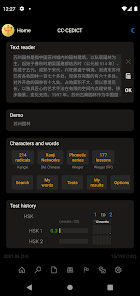
SmartHanzi is a free yet professional grade tool for students and anyone wishing to read real Chinese texts (web, PDF) even with a limited level in Chinese.
● Parse and lookup: read and learn
On tablet (landscape) or desktop, the left part of the window shows the current text or various lists with the text words.
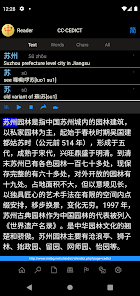
Text: clicking on a character shows a subview with all possible words at that position, starting with longer ones. Idiomatic expressions (chengyu, very common in Chinese) will usually show first.
Lists: words and characters in two separate lists (all characters, or only those not in a word) or a global list with the most probable words.
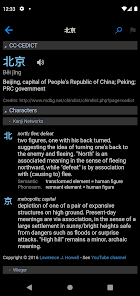
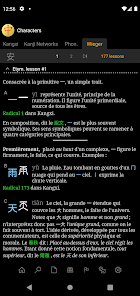
Right side: details for the selected word or character e.g stroke order, Kangxi keys, words containing (or contained in) the current word, and character components. Users select helpful fields.
Smartphones: compact presentation. The smartphone format can also be used on tablets in multi-application, side by side with the original text.
Putting together parsing (raw translations) and lookup details (stroke order, character components and more) helps learning while reading. With this perspective beyond immediate usage, one gets progressively more familiar with words and characters.
Advanced: besides recognizing the correspondence between simplified and traditional variants, SmartHanzi also recognizes multiple traditional variants. For instance, searching 真 (or finding 真 in a text) will show both 真 and 眞, according to what is present in selected dictionaries. Or it will recognize equally well 為 / 爲 or 眾 / 衆.
● Etymology: character components
Components as described by Kangxi keys, Dr. Wieger's etymological lessons and phonetic series, and Lawrence Howell's EDHCC (former Kanji Networks website).
Se non è vero, è ben trovato: with these components, Chinese culture has developed along centuries a number of well-known ways - or tricks - for memorizing. Trying to learn written Chinese without this invaluable assistance would be an unreasonable challenge.
● Dictionaries
Contemporary Chinese: English, German, French
DDB, CJKV-E: short definitions (see below)
Demo : Séraphin Couvreur's "Dictionnaire classique de la langue chinoise" (Chinese-French) with multiple example sentences and their source, from all periods of Chinese history, showing the evolution of character usage.
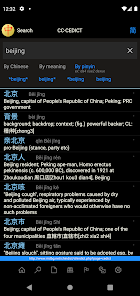
Options: select dictionaries; lists show all entries for a word, or just the first one; search by Chinese, meaning or pinyin.
● Tests
Quizzes based on HSK levels as a way to check one's progress. Progress shown on 12 months. Short tests, with errors reviewed first.
Options: longer tests; review unsure words or check supposedly known ones.
● DDB Access
DDB Access is a separate application similar to SmartHanzi, for the collaborative projects DDB (Digital Dictionary of Buddhism) and CJKV-E (Dictionary of Confucian, Daoist, and Intellectual Historical Terms).
Entries for DDB and CJKV-E are much more detailed in DDB Access.
Also on Google Play Store.
● Parse and lookup: read and learn
On tablet (landscape) or desktop, the left part of the window shows the current text or various lists with the text words.
Text: clicking on a character shows a subview with all possible words at that position, starting with longer ones. Idiomatic expressions (chengyu, very common in Chinese) will usually show first.
Lists: words and characters in two separate lists (all characters, or only those not in a word) or a global list with the most probable words.
Right side: details for the selected word or character e.g stroke order, Kangxi keys, words containing (or contained in) the current word, and character components. Users select helpful fields.
Smartphones: compact presentation. The smartphone format can also be used on tablets in multi-application, side by side with the original text.
Putting together parsing (raw translations) and lookup details (stroke order, character components and more) helps learning while reading. With this perspective beyond immediate usage, one gets progressively more familiar with words and characters.
Advanced: besides recognizing the correspondence between simplified and traditional variants, SmartHanzi also recognizes multiple traditional variants. For instance, searching 真 (or finding 真 in a text) will show both 真 and 眞, according to what is present in selected dictionaries. Or it will recognize equally well 為 / 爲 or 眾 / 衆.
● Etymology: character components
Components as described by Kangxi keys, Dr. Wieger's etymological lessons and phonetic series, and Lawrence Howell's EDHCC (former Kanji Networks website).
Se non è vero, è ben trovato: with these components, Chinese culture has developed along centuries a number of well-known ways - or tricks - for memorizing. Trying to learn written Chinese without this invaluable assistance would be an unreasonable challenge.
● Dictionaries
Contemporary Chinese: English, German, French
DDB, CJKV-E: short definitions (see below)
Demo : Séraphin Couvreur's "Dictionnaire classique de la langue chinoise" (Chinese-French) with multiple example sentences and their source, from all periods of Chinese history, showing the evolution of character usage.
Options: select dictionaries; lists show all entries for a word, or just the first one; search by Chinese, meaning or pinyin.
● Tests
Quizzes based on HSK levels as a way to check one's progress. Progress shown on 12 months. Short tests, with errors reviewed first.
Options: longer tests; review unsure words or check supposedly known ones.
● DDB Access
DDB Access is a separate application similar to SmartHanzi, for the collaborative projects DDB (Digital Dictionary of Buddhism) and CJKV-E (Dictionary of Confucian, Daoist, and Intellectual Historical Terms).
Entries for DDB and CJKV-E are much more detailed in DDB Access.
Also on Google Play Store.
Updated on
Safety starts with understanding how developers collect and share your data. Data privacy and security practices may vary based on your use, region and age. The developer provided this information and may update it over time.

No data shared with third parties
Learn more about how developers declare sharing

No data collected
Learn more about how developers declare collection
Ratings and reviews
5.0
56 reviews

A Google user
- Flag inappropriate
- Show review history
30 July 2019
whoever designed this really knows what they are doing. very efficient. Thanks a lot. The order of activities is logical, layout simple yet balanced. The less is more principal has been well applied. It's as if I designed this myself. All the features I want to learn Chinese are here: Ability to copy text into a reader, examples, hsk ordered quizzes; excellent.
17 people found this review helpful
Jean SOULAT
12 February 2019
Thank you so much, Roderick

Azhar Arih Rona
- Flag inappropriate
28 June 2020
I like it .... everything is perfect ... just want to give a little advice what if here is also added a feature of how to write hanzi strokes in the right order, it will be very helpful ... thanks :)
12 people found this review helpful
Jean SOULAT
28 June 2020
Thank you for your appreciation of SmartHanzi. Showing stroke order is something I am considering, but I still have to check what is technically and reasonably possible.

prismcool
- Flag inappropriate
5 June 2025
Great app to use for research in Chinese glyph origins but one problem...The app keeps crashing every time I use the search button. is there any fix for this?
Jean SOULAT
10 June 2025
Thank you for this report. Fixed with version 2025.06. It should be ok now.
What's new
Additional technical upgrade for Android 15.
App support
About the developer
Jean-Robert SOULAT
info@smarthanzi.net
France
undefined