
Light Unit Converter
4,0star
46 avis
10K+
Téléchargements

Tout public
info


À propos de l'application
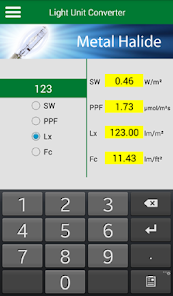
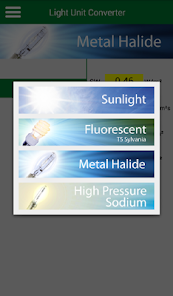
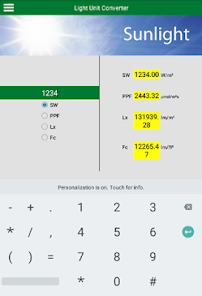
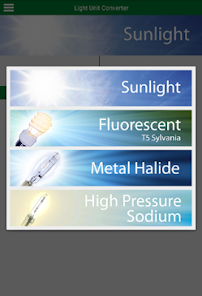
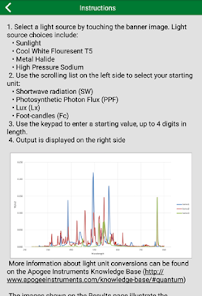
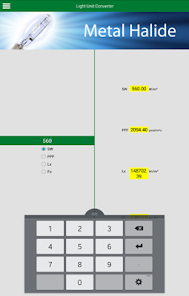
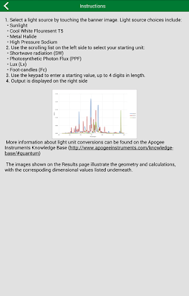
The Light Unit Converter app from Apogee Instruments calculates the conversions between different light units for various light sources including T5 Sylvania fluorescent lights, metal halide, high pressure sodium, and sunlight. Units include shortwave radiation (SW), photosynthetic photon flux (PPF, PPFD), Lux (lx) and Foot-candles (fc, lm/ft2, or ft-c).
Definitions:
Shortwave Radiation - Shortwave radiation (SW) is radiant energy with wavelengths in the visible (VIS), near-ultraviolet (UV), and near-infrared (NIR) spectra. There is no standard cut-off for the near-infrared range; therefore, the shortwave radiation range is also variously defined. It may be broadly defined to include all radiation with a wavelength between 0.1μm and 5.0μm or narrowly defined so as to include only radiation between 0.2μm and 3.0μm. There is little radiation flux (in terms of W/m²) to the Earth's surface below 0.2μm or above 3.0μm, although photon flux remains significant as far as 6.0μm, compared to shorter wavelength fluxes. UV-C radiation spans from 0.1μm to .28μm, UV-B from 0.28μm to 0.315μm, UV-A from 0.315μm to 0.4μm, the visible spectrum from 0.4μm to 0.7μm, and NIR arguably from 0.7μm to 5.0μm, beyond which the infrared is thermal. Shortwave radiation is distinguished from longwave radiation.
Lux - The lux (symbol: lx) is the SI unit of illuminance and luminous emittance, measuring luminous flux per unit area. It is equal to one lumen per square meter. In photometry, this is used as a measure of the intensity, as perceived by the human eye, of light that hits or passes through a surface. It is analogous to the radiometric unit watts per square meter, but with the power at each wavelength weighted according to the luminosity function, a standardized model of human visual brightness perception.
Photosynthetic Photon Flux - Photosynthetic Photon Flux (PPF), also known as Photosynthetic Photon Flux Density (PPFD) or Photosynthetically Active Radiation (PAR), designates the spectral range (wave band) of solar radiation from 400 to 700 nanometers that photosynthetic organisms are able to use in the process of photosynthesis. PAR measurement is used in agriculture, forestry and oceanography. One of the requirements for productive farmland is adequate PAR, so PAR is used to evaluate agricultural investment potential. PAR sensors stationed at various levels of the forest canopy measure the pattern of PAR availability and utilization. PAR is normally quantified as µmol photons/m2/s, which is a measure of the photosynthetic photon flux (area) density, or PPFD. PAR can also be expressed in energy units (irradiance, W/m2); this is relevant in energy-balance considerations for photosynthetic organisms. Because photosynthesis is a quantum process, PPFD is generally used by plant biologists.
Foot-candle - A foot-candle (sometimes foot candle; abbreviated fc, lm/ft2, or sometimes ft-c) is a non-SI unit of illuminance or light intensity widely used in the United States in photography, film, television, conservation lighting, greenhouse horticulture, the lighting industry, construction-related engineering and in building codes. The name "footcandle" conveys "the illuminance cast on a surface by a one-candela source one foot away". The unit is defined as the amount of illumination the inside surface of a one-foot-radius sphere would be receiving if there were a uniform point source of one candela in the exact center of the sphere. Alternatively, it can be defined as the illuminance on a one-square foot surface of which there is a uniformly distributed flux of one lumen. Thus one foot-candle is equal to one lumen per square foot or approximately 10.764 lux. In practical applications, as when measuring room illumination, it is very difficult to measure illuminance more accurately than ±10%, and for many purposes it is quite sufficient to think of one footcandle as about ten lux as is typically done in the lighting industry.
Definitions:
Shortwave Radiation - Shortwave radiation (SW) is radiant energy with wavelengths in the visible (VIS), near-ultraviolet (UV), and near-infrared (NIR) spectra. There is no standard cut-off for the near-infrared range; therefore, the shortwave radiation range is also variously defined. It may be broadly defined to include all radiation with a wavelength between 0.1μm and 5.0μm or narrowly defined so as to include only radiation between 0.2μm and 3.0μm. There is little radiation flux (in terms of W/m²) to the Earth's surface below 0.2μm or above 3.0μm, although photon flux remains significant as far as 6.0μm, compared to shorter wavelength fluxes. UV-C radiation spans from 0.1μm to .28μm, UV-B from 0.28μm to 0.315μm, UV-A from 0.315μm to 0.4μm, the visible spectrum from 0.4μm to 0.7μm, and NIR arguably from 0.7μm to 5.0μm, beyond which the infrared is thermal. Shortwave radiation is distinguished from longwave radiation.
Lux - The lux (symbol: lx) is the SI unit of illuminance and luminous emittance, measuring luminous flux per unit area. It is equal to one lumen per square meter. In photometry, this is used as a measure of the intensity, as perceived by the human eye, of light that hits or passes through a surface. It is analogous to the radiometric unit watts per square meter, but with the power at each wavelength weighted according to the luminosity function, a standardized model of human visual brightness perception.
Photosynthetic Photon Flux - Photosynthetic Photon Flux (PPF), also known as Photosynthetic Photon Flux Density (PPFD) or Photosynthetically Active Radiation (PAR), designates the spectral range (wave band) of solar radiation from 400 to 700 nanometers that photosynthetic organisms are able to use in the process of photosynthesis. PAR measurement is used in agriculture, forestry and oceanography. One of the requirements for productive farmland is adequate PAR, so PAR is used to evaluate agricultural investment potential. PAR sensors stationed at various levels of the forest canopy measure the pattern of PAR availability and utilization. PAR is normally quantified as µmol photons/m2/s, which is a measure of the photosynthetic photon flux (area) density, or PPFD. PAR can also be expressed in energy units (irradiance, W/m2); this is relevant in energy-balance considerations for photosynthetic organisms. Because photosynthesis is a quantum process, PPFD is generally used by plant biologists.
Foot-candle - A foot-candle (sometimes foot candle; abbreviated fc, lm/ft2, or sometimes ft-c) is a non-SI unit of illuminance or light intensity widely used in the United States in photography, film, television, conservation lighting, greenhouse horticulture, the lighting industry, construction-related engineering and in building codes. The name "footcandle" conveys "the illuminance cast on a surface by a one-candela source one foot away". The unit is defined as the amount of illumination the inside surface of a one-foot-radius sphere would be receiving if there were a uniform point source of one candela in the exact center of the sphere. Alternatively, it can be defined as the illuminance on a one-square foot surface of which there is a uniformly distributed flux of one lumen. Thus one foot-candle is equal to one lumen per square foot or approximately 10.764 lux. In practical applications, as when measuring room illumination, it is very difficult to measure illuminance more accurately than ±10%, and for many purposes it is quite sufficient to think of one footcandle as about ten lux as is typically done in the lighting industry.
Date de mise à jour
La sécurité, c'est d'abord comprendre comment les développeurs collectent et partagent vos données. Les pratiques concernant leur confidentialité et leur protection peuvent varier selon votre utilisation, votre région et votre âge. Le développeur a fourni ces informations et peut les modifier ultérieurement.

Aucune donnée partagée avec des tiers
En savoir plus sur la manière dont les développeurs déclarent le partage

Aucune donnée collectée
En savoir plus sur la manière dont les développeurs déclarent la collecte
Notes et avis
4,0
45 avis
Nouveautés
Updated for compatibility with Android 15
Assistance de l'appli
À propos du développeur
APOGEE INSTRUMENTS, INC.
developer@apogeeinstruments.com
721 W 1800 N
Logan, UT 84321
United States
+1 435-799-3066


