
Cavila: Riddles & Logic
In-app purchases


Everyone
info
10+
Downloads


About this app
Not memorizing answers: learning to find them. Logic, science and judgment riddles, from age 6.
One whole island, free forever. No ads, no internet needed and nothing your child can buy.
Your child will grow up surrounded by artificial intelligence, with machines that answer anything instantly. That's where CRITICAL THINKING stops being one more subject and becomes their key tool: knowing whether an answer holds up —who says it, what they gain if you believe it and how well it was tested— is the one thing no machine will do for them.
Skills like that will make people stand out. And they aren't learned as adults: critical thinking takes shape between ages 6 and 12, when a child is building the way of thinking they'll use for life.
Cavila trains exactly that. It isn't a riddle game for memorizing answers: it's where kids learn to find them.
HOW IT WORKS, AND WHY IT MATTERS
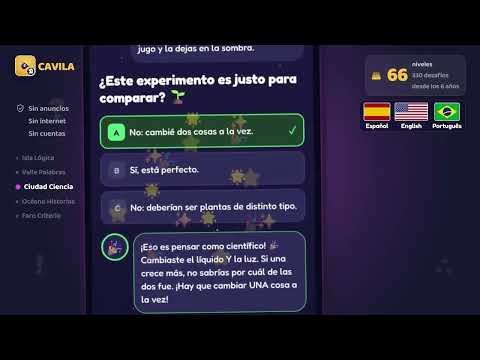
Gus is a crow who never says "wrong". When your child gets it wrong, Gus replies with a question: "what would happen if...?", and your child goes back to the problem instead of waiting to be told the answer. When they get it right, Gus DRAWS the reasoning step by step, because what sticks isn't getting it right: it's understanding why.
WHAT IT TRAINS
· Logic Island — reasoning and patterns
· Word Valley — language and argument
· Science City — scientific method and hypotheses
· Story Ocean — creativity and storytelling
· Judgment Lighthouse — noticing when something doesn't add up: who says it and how they know. It's the longest island: 18 levels.
JUDGMENT LIGHTHOUSE: WHAT NO OTHER APP HAS
Many people repeating it doesn't prove it. Two things happening together doesn't mean one caused the other. A number that doesn't say compared to what says nothing. And whoever rushes you wants you not to think.
It won't teach kids to distrust everything —a cynical child doesn't think better, they think less—: it teaches them to check one more thing before believing. With sneakers, giant cats and lucky T-shirts, which is where kids run into it.
WHAT'S INSIDE
· 66 levels, each with 5 different challenges: choose with a reason, order steps and match ideas.
· Challenges adapt to your child's age, from age 6.
· Gus's Nest: 100 amazing facts in 10 nooks. No questions and no scores: looking is learning too.
· Daily Challenge and streak, so they come back tomorrow.
· Up to 4 children on the same phone, each with their own progress and report.
· Orchestral background music that lowers itself when it's time to think.
WHAT IT DOESN'T HAVE, AND NEVER WILL
· No ads. None, anywhere.
· No internet needed: the whole game works in airplane mode.
· Your child can't buy anything. The stars in the game are earned by thinking.
· We don't ask for a name, email or exact age. Progress stays on the phone, and uninstalling the app erases it all.
· A gated Parents' Area: see how your child reasons and where they're growing.
WHAT'S FREE AND WHAT'S PREMIUM
Free: Logic Island COMPLETE —its 12 levels, 60 challenges, up to the final challenge— and two nooks of the Nest. It's not a three-screen demo: it's a whole island your child can finish and celebrate, with no countdown and no lives.
Premium: the other four islands —Word Valley, Science City, Story Ocean and Judgment Lighthouse—, 270 more challenges and the other eight nooks of the Nest. An adult unlocks it, you can cancel anytime and what your child already played never expires.
And Premium comes with a 7-DAY FREE TRIAL, with all five islands open. Google Play runs it, asks for a payment method and you cancel it there. The part above doesn't: Logic Island is free forever, no card and no account.
WHY IT'S WORTH IT
Because the Lighthouse is on the paid side, and the Lighthouse is why this app exists. Logic games are everywhere; teaching a child to ask where what they're told came from is something almost nobody does. It costs less than a coffee a month, and the yearly plan is less than half of twelve months.
Made by a dad.
One whole island, free forever. No ads, no internet needed and nothing your child can buy.
Your child will grow up surrounded by artificial intelligence, with machines that answer anything instantly. That's where CRITICAL THINKING stops being one more subject and becomes their key tool: knowing whether an answer holds up —who says it, what they gain if you believe it and how well it was tested— is the one thing no machine will do for them.
Skills like that will make people stand out. And they aren't learned as adults: critical thinking takes shape between ages 6 and 12, when a child is building the way of thinking they'll use for life.
Cavila trains exactly that. It isn't a riddle game for memorizing answers: it's where kids learn to find them.
HOW IT WORKS, AND WHY IT MATTERS
Gus is a crow who never says "wrong". When your child gets it wrong, Gus replies with a question: "what would happen if...?", and your child goes back to the problem instead of waiting to be told the answer. When they get it right, Gus DRAWS the reasoning step by step, because what sticks isn't getting it right: it's understanding why.
WHAT IT TRAINS
· Logic Island — reasoning and patterns
· Word Valley — language and argument
· Science City — scientific method and hypotheses
· Story Ocean — creativity and storytelling
· Judgment Lighthouse — noticing when something doesn't add up: who says it and how they know. It's the longest island: 18 levels.
JUDGMENT LIGHTHOUSE: WHAT NO OTHER APP HAS
Many people repeating it doesn't prove it. Two things happening together doesn't mean one caused the other. A number that doesn't say compared to what says nothing. And whoever rushes you wants you not to think.
It won't teach kids to distrust everything —a cynical child doesn't think better, they think less—: it teaches them to check one more thing before believing. With sneakers, giant cats and lucky T-shirts, which is where kids run into it.
WHAT'S INSIDE
· 66 levels, each with 5 different challenges: choose with a reason, order steps and match ideas.
· Challenges adapt to your child's age, from age 6.
· Gus's Nest: 100 amazing facts in 10 nooks. No questions and no scores: looking is learning too.
· Daily Challenge and streak, so they come back tomorrow.
· Up to 4 children on the same phone, each with their own progress and report.
· Orchestral background music that lowers itself when it's time to think.
WHAT IT DOESN'T HAVE, AND NEVER WILL
· No ads. None, anywhere.
· No internet needed: the whole game works in airplane mode.
· Your child can't buy anything. The stars in the game are earned by thinking.
· We don't ask for a name, email or exact age. Progress stays on the phone, and uninstalling the app erases it all.
· A gated Parents' Area: see how your child reasons and where they're growing.
WHAT'S FREE AND WHAT'S PREMIUM
Free: Logic Island COMPLETE —its 12 levels, 60 challenges, up to the final challenge— and two nooks of the Nest. It's not a three-screen demo: it's a whole island your child can finish and celebrate, with no countdown and no lives.
Premium: the other four islands —Word Valley, Science City, Story Ocean and Judgment Lighthouse—, 270 more challenges and the other eight nooks of the Nest. An adult unlocks it, you can cancel anytime and what your child already played never expires.
And Premium comes with a 7-DAY FREE TRIAL, with all five islands open. Google Play runs it, asks for a payment method and you cancel it there. The part above doesn't: Logic Island is free forever, no card and no account.
WHY IT'S WORTH IT
Because the Lighthouse is on the paid side, and the Lighthouse is why this app exists. Logic games are everywhere; teaching a child to ask where what they're told came from is something almost nobody does. It costs less than a coffee a month, and the yearly plan is less than half of twelve months.
Made by a dad.
Logic riddles that build good judgment. No ads and no internet needed.
Updated on
Safety starts with understanding how developers collect and share your data. Data privacy and security practices may vary based on your use, region, and age. The developer provided this information and may update it over time.
- No data shared with third partiesLearn more about how developers declare sharing
- This app may collect these data typesDevice or other IDs
- Data is encrypted in transit


What’s new
Cavila now speaks English and Portuguese, as well as Spanish.
We went through the whole app so it looks and sounds clear on any phone.
And you can pick the language in the Parents' Area: Spanish, English or Portuguese, anytime.
Premium is offered twice in the first week and never more than once a month, always behind the grown-up gate.
We keep polishing Cavila version after version. Thanks for coming along!
We went through the whole app so it looks and sounds clear on any phone.
And you can pick the language in the Parents' Area: Spanish, English or Portuguese, anytime.
Premium is offered twice in the first week and never more than once a month, always behind the grown-up gate.
We keep polishing Cavila version after version. Thanks for coming along!
App support
About the developer
Gustavo Andres Gomez Galaz
contacto@gusmarstudios.com
Casa Casa
Los Diaguitas 1145
8150000 Puente Alto
Región Metropolitana
Chile