
Aurora Forecast 3D

4.1star
292 reviews
100K+
Downloads

Everyone
info

About this app
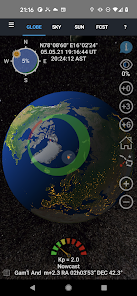
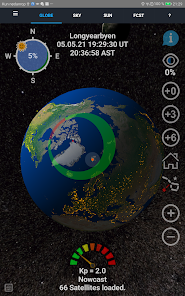
The Aurora Forecast 3D is a tool to track down where the aurora is located in the sky from any location on planet. It renders Earth in 3D with rotation and scaling at your fingertips. You can select locations and make your own ground - station list. The Sun illuminates the globe as it updates in near real-time. The short term forecasts are up to +6 hours, while the long term forecasts are up to 3 days ahead in time. They are updated when the app is active and connected to internet.
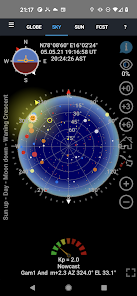
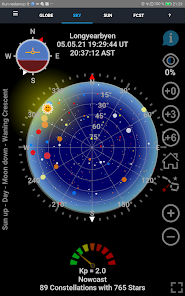
An Aurora Compass is included that shows where the auroral oval [1,2], the Moon and the Sun are located as you look up at the sky from your location. The phase and age of the Moon is also visualized in the compass. By zooming out in the 3D view port, satellites, stars and planets appear in their orbits [3] around the Sun.
FEATURES
- 3D view port of Earth.
- Solar illumination of the Earth and the Moon.
- Aurora oval size and location in real time.
- Day side location of the red Cusp.
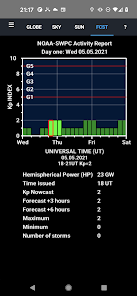
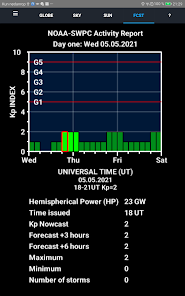
- Forecasts based on predicted Kp index estimated by the Space Weather Prediction Centre (NOAA-SWPC).
- Includes a 2.4 million star map [4].
- City light texture [5].
- Earth, Sun and Moon textures [6,7].
- Sky view module to track planets and stars [8].
- 3-day space weather condition forecast as news ticker.
- Two-Line Element (TLE) satellite orbit calculations [9].
- Skyview navigation.
- 3D Laser Star pointer to identify star signs.
- Sounding rocket trajectories.
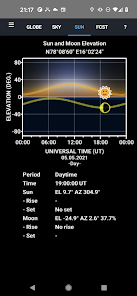
- Sun and Moon daily elevation plots with rise and set time.
- Epoch selection for magnetic pole position [10]
- Ovals based on polar orbiting satellites data [11]
- Target web links added to satellites, stars, planets and position.
- All-sky camera links to the Boreal Aurora Camera Constellation (BACC).
- Sky color animation [12,13].
- Zhang and Paxton ovals added [14]
- Geomagnetic storm push notifications.
- Youtube demonstration.
References
[1] Sigernes F., M. Dyrland, P. Brekke, S. Chernouss, D.A. Lorentzen, K. Oksavik, and C.S. Deehr, Two methods to forecast auroral displays, Journal of Space Weather and Space Climate (SWSC), Vol. 1, No. 1, A03, DOI:10.1051/swsc/2011003, 2011.
[2] Starkov G. V., Mathematical model of the auroral boundaries, Geomagnetism and Aeronomy, 34 (3), 331-336, 1994.
[3] P. Schlyter, How to compute planetary positions, http://stjarnhimlen.se/, Stockholm, Sweden.
[4] Bridgman, T. and Wright, E., The Tycho Catalog Sky map- Version 2.0, NASA/Goddard Space Flight Center Scientific Visualization Studio, http://svs.gsfc.nasa.gov/3572, January 26, 2009.
[5] The Visible Earth catalog, http://visibleearth.nasa.gov/, NASA/Goddard Space Flight Center, April-October, 2012.
[6] T. Patterson, Natural Earth III - Texture Maps, http://www.shadedrelief.com, October 1, 2016.
[7] Nexus - Planet Textures, http://www.solarsystemscope.com/nexus/, January 4, 2013.
[8] Hoffleit, D. and Warren, Jr., W.H., The Bright Star Catalog, 5th Revised Edition (Preliminary Version), Astronomical Data Center, NSSDC/ADC, 1991.
[9] Vallado, David A., Paul Crawford, Richard Hujsak, and T.S. Kelso, Revisiting Spacetrack Report #3, AIAA/AAS-2006-6753, https://celestrak.com, 2006.
[10] Tsyganenko, N.A., Secular drift of the auroral ovals: How fast do they actually move?, Geophysical Research Letters, 46, 3017-3023, 2019.
[11] M. J. Breedveld, Predicting the Auroral Oval Boundaries by Means of Polar Operational Environmental Satellite Particle Precipitation Data, Master thesis, Department of Physics and Technology, Faculty of Science and Technology, The Arctic University of Norway, June 2020.
[12] Perez, R., J,M. Seals and B. Smith, An all-weather model for sky illuminance distribution, Solar Energy, 1993.
[13] Preetham, A.J, P. Shirley and B. Smith, A practical model for daylight Computer Graphics, (SIGGRAPH 99 Proceedings), 91-100, 1999.
[14] Zhang Y., and L. J. Paxton, An empirical Kp-dependent global auroral model based on TIMED/GUVI data, J. Atm. Solar-Terr. Phys., 70, 1231-1242, 2008.
An Aurora Compass is included that shows where the auroral oval [1,2], the Moon and the Sun are located as you look up at the sky from your location. The phase and age of the Moon is also visualized in the compass. By zooming out in the 3D view port, satellites, stars and planets appear in their orbits [3] around the Sun.
FEATURES
- 3D view port of Earth.
- Solar illumination of the Earth and the Moon.
- Aurora oval size and location in real time.
- Day side location of the red Cusp.
- Forecasts based on predicted Kp index estimated by the Space Weather Prediction Centre (NOAA-SWPC).
- Includes a 2.4 million star map [4].
- City light texture [5].
- Earth, Sun and Moon textures [6,7].
- Sky view module to track planets and stars [8].
- 3-day space weather condition forecast as news ticker.
- Two-Line Element (TLE) satellite orbit calculations [9].
- Skyview navigation.
- 3D Laser Star pointer to identify star signs.
- Sounding rocket trajectories.
- Sun and Moon daily elevation plots with rise and set time.
- Epoch selection for magnetic pole position [10]
- Ovals based on polar orbiting satellites data [11]
- Target web links added to satellites, stars, planets and position.
- All-sky camera links to the Boreal Aurora Camera Constellation (BACC).
- Sky color animation [12,13].
- Zhang and Paxton ovals added [14]
- Geomagnetic storm push notifications.
- Youtube demonstration.
References
[1] Sigernes F., M. Dyrland, P. Brekke, S. Chernouss, D.A. Lorentzen, K. Oksavik, and C.S. Deehr, Two methods to forecast auroral displays, Journal of Space Weather and Space Climate (SWSC), Vol. 1, No. 1, A03, DOI:10.1051/swsc/2011003, 2011.
[2] Starkov G. V., Mathematical model of the auroral boundaries, Geomagnetism and Aeronomy, 34 (3), 331-336, 1994.
[3] P. Schlyter, How to compute planetary positions, http://stjarnhimlen.se/, Stockholm, Sweden.
[4] Bridgman, T. and Wright, E., The Tycho Catalog Sky map- Version 2.0, NASA/Goddard Space Flight Center Scientific Visualization Studio, http://svs.gsfc.nasa.gov/3572, January 26, 2009.
[5] The Visible Earth catalog, http://visibleearth.nasa.gov/, NASA/Goddard Space Flight Center, April-October, 2012.
[6] T. Patterson, Natural Earth III - Texture Maps, http://www.shadedrelief.com, October 1, 2016.
[7] Nexus - Planet Textures, http://www.solarsystemscope.com/nexus/, January 4, 2013.
[8] Hoffleit, D. and Warren, Jr., W.H., The Bright Star Catalog, 5th Revised Edition (Preliminary Version), Astronomical Data Center, NSSDC/ADC, 1991.
[9] Vallado, David A., Paul Crawford, Richard Hujsak, and T.S. Kelso, Revisiting Spacetrack Report #3, AIAA/AAS-2006-6753, https://celestrak.com, 2006.
[10] Tsyganenko, N.A., Secular drift of the auroral ovals: How fast do they actually move?, Geophysical Research Letters, 46, 3017-3023, 2019.
[11] M. J. Breedveld, Predicting the Auroral Oval Boundaries by Means of Polar Operational Environmental Satellite Particle Precipitation Data, Master thesis, Department of Physics and Technology, Faculty of Science and Technology, The Arctic University of Norway, June 2020.
[12] Perez, R., J,M. Seals and B. Smith, An all-weather model for sky illuminance distribution, Solar Energy, 1993.
[13] Preetham, A.J, P. Shirley and B. Smith, A practical model for daylight Computer Graphics, (SIGGRAPH 99 Proceedings), 91-100, 1999.
[14] Zhang Y., and L. J. Paxton, An empirical Kp-dependent global auroral model based on TIMED/GUVI data, J. Atm. Solar-Terr. Phys., 70, 1231-1242, 2008.
Updated on
Safety starts with understanding how developers collect and share your data. Data privacy and security practices may vary based on your use, region, and age. The developer provided this information and may update it over time.

No data shared with third parties
Learn more about how developers declare sharing

No data collected
Learn more about how developers declare collection
Ratings and reviews
4.1
275 reviews

Michael Leonard
- Flag inappropriate
- Show review history
November 4, 2024
That was great if you live in one of the predetermined towns or where Fred lives. I tried having the app find my location and it always puts me at Fred's place. There doesn't seem to be any way to have it use the GPS in the phone to position yourself on the map. Hopefully this will be updated as the app does look to be very good otherwise. I keep getting the little warning triangle telling me that it's not connected to the internet yet everything else works proving internet is connected.
1 person found this review helpful
Fred Sigernes
January 29, 2025
Yes, I will double check the location permission in the app. The warning is due to loss of server connection. It should be fixed now.

Aenor Rose
- Flag inappropriate
- Show review history
January 29, 2025
Was a great app to get notified in advance of possible aurora, and view regular updates of the NOAA forecast... Until the notifications stopped working. I don't receive any now, and haven't for months. Missed several possible opportunities as a result. Edit to reply to dev: So the developer DELIBERATELY REMOVED the most useful feature, rather than instructing users how to use their phone settings to turn off notifications. Dumb and useless. One star, uninstalled.
1 person found this review helpful
Fred Sigernes
January 29, 2025
Sorry, I decided to quit push notification from user feedback and 3 party dependence that takes to much time. Just start the app when you are ready for an aurora mission. Or let it run on a computer.

John Pottle
- Flag inappropriate
November 2, 2021
This app is visually very appealing, has some great features, and is pretty easy to use once you get used to it. The help feature and video are pretty good, but might need to be updated for the current version. For example, I can see how to add a station, but not edit the name. I see a few other things on the globe display, but don't see an explanation of what they are (yellow map pin?). I look forward to seeing if the aurora visibility indication is accurate! Cool app.
30 people found this review helpful
Fred Sigernes
June 1, 2023
Thanks for feedback. To edit the station name, Hit the underlines "Name" link. That opens the text box for edit. Hit Enter key to change.
What’s new
New improved magnetic model based on AACGM-v2.
App support
About the developer
Fred Sigernes
freds@unis.no
Norway


