
Electrochemistry Notes
Contains adsIn-app purchases

Everyone
info
100+
Downloads

Everyone
Learn more




About this app
📘 Electrochemistry Notes (2026–2027 Edition)
Electrochemistry Notes (2026–2027 Edition) is a comprehensive, research-oriented textbook designed for students, educators, and professionals in chemistry, materials science, analytical chemistry, and chemical engineering. This book provides an in-depth understanding of electrochemical principles, instrumentation, reaction mechanisms, energy conversion, and industrial applications.
It bridges theoretical concepts with practical applications. Readers will gain insights into electrochemical cells, electrode processes, kinetics, corrosion, batteries, fuel cells, energy storage, and modern analytical techniques.
⚛️ Unit 1: Introduction to Electrochemistry
• Scope and importance of electrochemistry
• Historical background and development
• Basic terminology: electrode, electrolyte, ion, redox, potential
• Types of electrochemical systems
🔢 Unit 2: Electrolytic Conductance and Ionic Mobility
• Electrolytes and non-electrolytes
• Conductivity and molar conductivity
• Kohlrausch’s Law and applications
• Ion mobility and transference numbers
• Factors affecting conductance: temperature, concentration, viscosity
📐 Unit 3: Electrochemical Cells and EMF
• Galvanic vs. electrolytic cells
• Cell diagrams and conventions
• Electromotive force (EMF) of a cell
• Reversible and irreversible cells
• Measurement and applications of EMF
🔹 Unit 4: Thermodynamics of Electrochemical Cells
• Gibbs free energy and EMF
• Helmholtz and Gibbs-Helmholtz equations
• Nernst equation: derivation and applications
• Temperature dependence of EMF
• Equilibrium constants and cell potential
🌀 Unit 5: Electrodes and Electrode Potentials
• Standard hydrogen electrode (SHE)
• Reference electrodes: calomel, Ag-AgCl
• Electrochemical series and standard electrode potentials
• Redox potentials and spontaneity
• Types of electrodes: inert, metal-metal ion, gas, redox, amalgam
⚡ Unit 6: Conductometric and Potentiometric Methods
• Principles of conductometric titrations
• Types of conductometric titrations
• Principle and applications of potentiometry
• Acid-base, redox, and precipitation titrations
• Instrumentation and calibration
🧩 Unit 7: Electrochemical Kinetics and Overpotential
• Electrode reaction mechanisms
• Butler–Volmer and Tafel equations
• Overpotentials: activation, concentration, ohmic
• Exchange current density and reaction rates
🔬 Unit 8: Concentration Cells and Liquid Junction Potential
• Types of concentration cells
• EMF of cells with and without transference
• Role and elimination of liquid junction potential
• Analytical applications
📊 Unit 9: Ion-Selective and Membrane Electrodes
• Principles of ion-selective electrodes (ISE)
• Glass electrodes: construction and working
• Applications in pH and ion analysis
• Membrane potential and Donnan equilibrium
📏 Unit 10: Corrosion and Its Control
• Thermodynamics and kinetics of corrosion
• Types: galvanic, pitting, crevice, intergranular
• Pourbaix diagrams
• Corrosion protection: coatings, inhibitors, cathodic protection
📐 Unit 11: Electrolysis and Industrial Electrochemistry
• Electrolysis of molten salts and aqueous solutions
• Faraday’s laws of electrolysis
• Industrial processes: electrorefining, electroplating, chlor-alkali
• Electrometallurgy and anodizing
🔹 Unit 12: Batteries and Fuel Cells
• Primary and secondary batteries: lead-acid, Li-ion, NiMH
• Battery performance: voltage, capacity, energy density
• Fuel cells: H₂-O₂, methanol, SOFC
• Design and efficiency of fuel cells
✨ This app is inspired by the authors:
Allen J. Bard, Larry R. Faulkner, C. M. A. Brett, and A. M. O. Brett.
📲 Download Electrochemistry (2026–2027 Edition) to master electrochemical theory, experimental techniques, energy applications, and industrial processes. Ideal for students, educators, and researchers in chemistry, materials science, and chemical engineering.
Electrochemistry Notes (2026–2027 Edition) is a comprehensive, research-oriented textbook designed for students, educators, and professionals in chemistry, materials science, analytical chemistry, and chemical engineering. This book provides an in-depth understanding of electrochemical principles, instrumentation, reaction mechanisms, energy conversion, and industrial applications.
It bridges theoretical concepts with practical applications. Readers will gain insights into electrochemical cells, electrode processes, kinetics, corrosion, batteries, fuel cells, energy storage, and modern analytical techniques.
⚛️ Unit 1: Introduction to Electrochemistry
• Scope and importance of electrochemistry
• Historical background and development
• Basic terminology: electrode, electrolyte, ion, redox, potential
• Types of electrochemical systems
🔢 Unit 2: Electrolytic Conductance and Ionic Mobility
• Electrolytes and non-electrolytes
• Conductivity and molar conductivity
• Kohlrausch’s Law and applications
• Ion mobility and transference numbers
• Factors affecting conductance: temperature, concentration, viscosity
📐 Unit 3: Electrochemical Cells and EMF
• Galvanic vs. electrolytic cells
• Cell diagrams and conventions
• Electromotive force (EMF) of a cell
• Reversible and irreversible cells
• Measurement and applications of EMF
🔹 Unit 4: Thermodynamics of Electrochemical Cells
• Gibbs free energy and EMF
• Helmholtz and Gibbs-Helmholtz equations
• Nernst equation: derivation and applications
• Temperature dependence of EMF
• Equilibrium constants and cell potential
🌀 Unit 5: Electrodes and Electrode Potentials
• Standard hydrogen electrode (SHE)
• Reference electrodes: calomel, Ag-AgCl
• Electrochemical series and standard electrode potentials
• Redox potentials and spontaneity
• Types of electrodes: inert, metal-metal ion, gas, redox, amalgam
⚡ Unit 6: Conductometric and Potentiometric Methods
• Principles of conductometric titrations
• Types of conductometric titrations
• Principle and applications of potentiometry
• Acid-base, redox, and precipitation titrations
• Instrumentation and calibration
🧩 Unit 7: Electrochemical Kinetics and Overpotential
• Electrode reaction mechanisms
• Butler–Volmer and Tafel equations
• Overpotentials: activation, concentration, ohmic
• Exchange current density and reaction rates
🔬 Unit 8: Concentration Cells and Liquid Junction Potential
• Types of concentration cells
• EMF of cells with and without transference
• Role and elimination of liquid junction potential
• Analytical applications
📊 Unit 9: Ion-Selective and Membrane Electrodes
• Principles of ion-selective electrodes (ISE)
• Glass electrodes: construction and working
• Applications in pH and ion analysis
• Membrane potential and Donnan equilibrium
📏 Unit 10: Corrosion and Its Control
• Thermodynamics and kinetics of corrosion
• Types: galvanic, pitting, crevice, intergranular
• Pourbaix diagrams
• Corrosion protection: coatings, inhibitors, cathodic protection
📐 Unit 11: Electrolysis and Industrial Electrochemistry
• Electrolysis of molten salts and aqueous solutions
• Faraday’s laws of electrolysis
• Industrial processes: electrorefining, electroplating, chlor-alkali
• Electrometallurgy and anodizing
🔹 Unit 12: Batteries and Fuel Cells
• Primary and secondary batteries: lead-acid, Li-ion, NiMH
• Battery performance: voltage, capacity, energy density
• Fuel cells: H₂-O₂, methanol, SOFC
• Design and efficiency of fuel cells
✨ This app is inspired by the authors:
Allen J. Bard, Larry R. Faulkner, C. M. A. Brett, and A. M. O. Brett.
📲 Download Electrochemistry (2026–2027 Edition) to master electrochemical theory, experimental techniques, energy applications, and industrial processes. Ideal for students, educators, and researchers in chemistry, materials science, and chemical engineering.
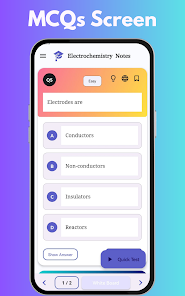
Electrochemistry Notes with Syllabus, MCQs and Quizzes for exam preparation
Updated on
Safety starts with understanding how developers collect and share your data. Data privacy and security practices may vary based on your use, region, and age. The developer provided this information and may update it over time.
- No data shared with third partiesLearn more about how developers declare sharing
- No data collectedLearn more about how developers declare collection
- Data is encrypted in transit
- Data can’t be deleted


What’s new
🚀 New Update of Electrochemistry Notes (2026–2027 Edition)
✨ What’s Inside:
✅ Fundamentals of electrochemistry, electrodes, and ionic conductance
✅ Electrochemical cells, EMF, thermodynamics, and kinetics
✅ MCQs and Quizzes for exam preparation
🎯 Suitable For:
👩🎓 Students of Chemistry, Chemical Engineering, and Material Science
🏆 Ideal for exams, research projects, lab work, and industry-focused learning
Start mastering Electrochemistry Notes (2026–2027 Edition) today!
✨ What’s Inside:
✅ Fundamentals of electrochemistry, electrodes, and ionic conductance
✅ Electrochemical cells, EMF, thermodynamics, and kinetics
✅ MCQs and Quizzes for exam preparation
🎯 Suitable For:
👩🎓 Students of Chemistry, Chemical Engineering, and Material Science
🏆 Ideal for exams, research projects, lab work, and industry-focused learning
Start mastering Electrochemistry Notes (2026–2027 Edition) today!
Everyone
Learn moreApp support
About the developer
kamran Ahmed
kamahm707@gmail.com
Sheer Orah Post Office, Sheer Hafizabad, Pallandri, District Sudhnoti
Pallandri AJK, 12010
Pakistan


