
taskcalc

Everyone
info
1+
Downloads

Everyone
Learn more



About this app
taskcalc was born from knowledge in the logistics field.
"taskcalc", which is a combination of "task" and "calculate", is a work management application born from practical experience in a distribution warehouse. It was developed from an on-site perspective in order to respond to the simple need faced on-site: ``I want to accurately understand how much work it will take to complete.''
Main functions developed based on feedback from the field
Real-time working time prediction
We calculate the completion time from the amount of work per hour for the most important issue in logistics warehouse work: ``When will it be finished?'' We respond flexibly to sudden additions or changes to work, and always provide the latest estimated completion times.
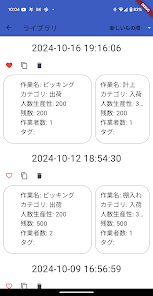
Work library function
This function was born from the knowledge accumulated at daily logistics sites. You can save frequently occurring work patterns as a library and recall them quickly when needed. It minimizes the effort required to register work and improves on-site efficiency.
Performance management by worker
Reflects the reality of workplaces where workers of various skill levels, from veterans to newcomers, coexist. Individual worker ability values can be set as parameters, making it possible to predict work hours more realistically.
Interface designed for ease of use
Based on experience in use at logistics sites, it has been designed to allow work registration with the minimum number of operations required. Adopts drop-down selection input, allowing you to input quickly and without mistakes even when you are in a hurry.
Work analysis function (under development)
Comparative analysis of predicted time and actual results based on accumulated data. Visualize work progress in real time and support more efficient business improvements.
Potential for use in various industries beyond logistics
The functionality of taskcalc, which has been cultivated in logistics sites, has the potential to be used in various industries that require prediction and management of work time.
Example of use in manufacturing industry
Production line work time management
Prediction of time required for each process
Worker skill management and appropriate placement
Possibilities in the construction industry
Construction process progress management
Support for organizing work teams
Calculation of time required for each process
Development in retail industry
Store work time management
Staff shift optimization
Workload visualization
Application to service industry
Work standardization support
Optimization of staffing
Prediction of service delivery time
Business improvement brought about by taskcalc
Visualization of work
Automatically calculate completion time from work amount
Understand real-time progress
Creating work plans based on data
Achieving efficiency
Reduction of work registration time
Achieving optimal staffing
Reducing unnecessary waiting time
Improving the workplace environment
Appropriate distribution of workload
Management based on objective data
Supporting efficient skill transfer
Accumulation of work patterns
Improvement through budget and actual management
Knowledge sharing and utilization
Future outlook
Taskcalc, which originated in logistics sites, has the potential to provide new solutions to work management issues faced at various industrial sites. We plan to further expand its functionality, including analysis functions currently under development, with the aim of making it useful in even more diverse business situations.
We will provide solutions that utilize the know-how cultivated in the logistics field to address the universal problem of "predicting and managing work hours" that is common in different industries.
Conclusion
taskcalc is a work management tool that was born out of logistics field practices and continues to evolve in response to the voices of the field. This is a test version under development. Please feel free to try it. We look forward to discovering new ways to use it in your workplace.
"taskcalc", which is a combination of "task" and "calculate", is a work management application born from practical experience in a distribution warehouse. It was developed from an on-site perspective in order to respond to the simple need faced on-site: ``I want to accurately understand how much work it will take to complete.''
Main functions developed based on feedback from the field
Real-time working time prediction
We calculate the completion time from the amount of work per hour for the most important issue in logistics warehouse work: ``When will it be finished?'' We respond flexibly to sudden additions or changes to work, and always provide the latest estimated completion times.
Work library function
This function was born from the knowledge accumulated at daily logistics sites. You can save frequently occurring work patterns as a library and recall them quickly when needed. It minimizes the effort required to register work and improves on-site efficiency.
Performance management by worker
Reflects the reality of workplaces where workers of various skill levels, from veterans to newcomers, coexist. Individual worker ability values can be set as parameters, making it possible to predict work hours more realistically.
Interface designed for ease of use
Based on experience in use at logistics sites, it has been designed to allow work registration with the minimum number of operations required. Adopts drop-down selection input, allowing you to input quickly and without mistakes even when you are in a hurry.
Work analysis function (under development)
Comparative analysis of predicted time and actual results based on accumulated data. Visualize work progress in real time and support more efficient business improvements.
Potential for use in various industries beyond logistics
The functionality of taskcalc, which has been cultivated in logistics sites, has the potential to be used in various industries that require prediction and management of work time.
Example of use in manufacturing industry
Production line work time management
Prediction of time required for each process
Worker skill management and appropriate placement
Possibilities in the construction industry
Construction process progress management
Support for organizing work teams
Calculation of time required for each process
Development in retail industry
Store work time management
Staff shift optimization
Workload visualization
Application to service industry
Work standardization support
Optimization of staffing
Prediction of service delivery time
Business improvement brought about by taskcalc
Visualization of work
Automatically calculate completion time from work amount
Understand real-time progress
Creating work plans based on data
Achieving efficiency
Reduction of work registration time
Achieving optimal staffing
Reducing unnecessary waiting time
Improving the workplace environment
Appropriate distribution of workload
Management based on objective data
Supporting efficient skill transfer
Accumulation of work patterns
Improvement through budget and actual management
Knowledge sharing and utilization
Future outlook
Taskcalc, which originated in logistics sites, has the potential to provide new solutions to work management issues faced at various industrial sites. We plan to further expand its functionality, including analysis functions currently under development, with the aim of making it useful in even more diverse business situations.
We will provide solutions that utilize the know-how cultivated in the logistics field to address the universal problem of "predicting and managing work hours" that is common in different industries.
Conclusion
taskcalc is a work management tool that was born out of logistics field practices and continues to evolve in response to the voices of the field. This is a test version under development. Please feel free to try it. We look forward to discovering new ways to use it in your workplace.
Updated on
Safety starts with understanding how developers collect and share your data. Data privacy and security practices may vary based on your use, region, and age. The developer provided this information and may update it over time.

No data shared with third parties
Learn more about how developers declare sharing

No data collected
Learn more about how developers declare collection
What’s new
バグフィックスです。
Everyone
Learn moreApp support
phone
Phone number
+818034900387
About the developer
山﨑哲平
t.yamazaki11@gmail.com
日本
〒203-0002 東京都東久留米市
神宝町1丁目11−27


